
Anxiety is one of the major issues that brings clients to therapy. Especially in the stressful and uncertain times that we live in, more and more people are experiencing worried thoughts and a feeling of being on-edge, and they come to us seeking relief from those symptoms.
Rumination is one of the key, if not definitive, symptoms associated with anxiety, and it refers to an unpleasant and sustained engagement with our thoughts. While some interventions highlight the role of negative beliefs and muscle tension in anxiety, we may sometimes overlook addressing rumination in treating anxiety.
In this article, we’ll review what rumination is, how it contributes to anxiety, and ways that we can empower our clients to overcome it. By doing so, we can help our clients to live more meaningful, anxiety-free lives.
Defining Rumination to Clients
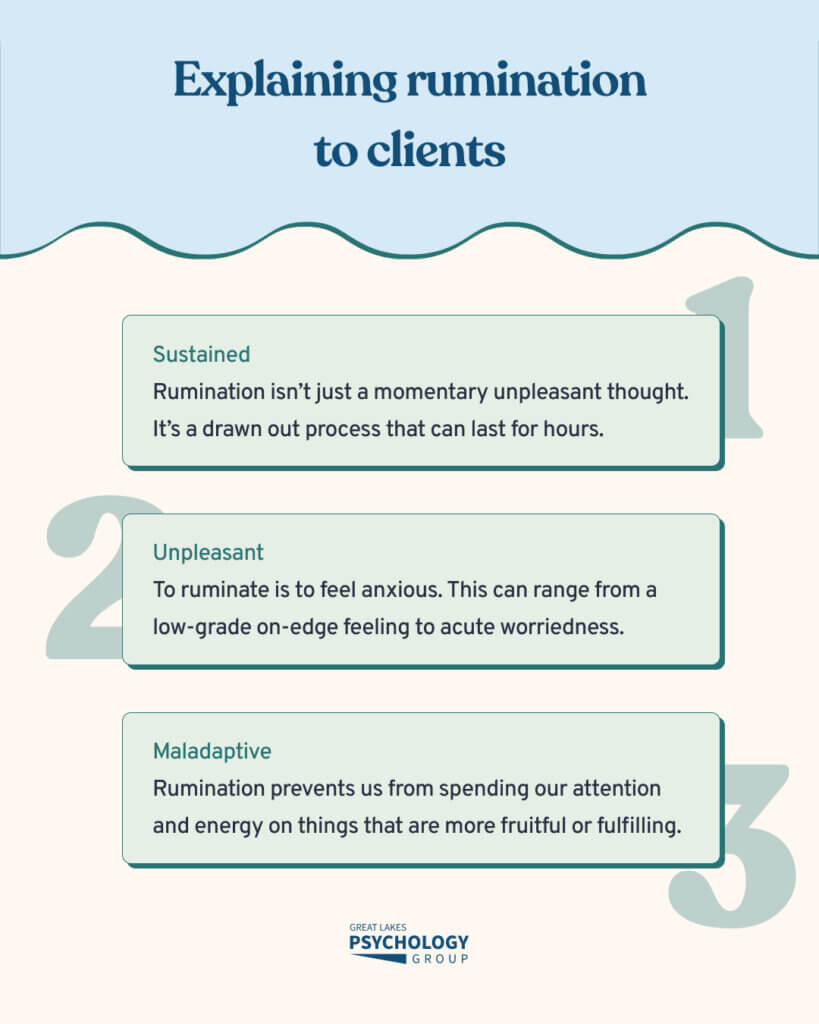
The first step in addressing rumination with clients is to explain what it is. My shorthand definition of rumination is the following: Rumination is a pattern of sustained, unpleasant, and maladaptive thinking.
As the italics suggest, there are three major features to rumination:
- Sustained. Rumination isn’t just a momentary unpleasant thought or remembrance. It’s a drawn-out process that can even last for hours.
- Unpleasant. To ruminate is to feel anxious. This can range from a low-grade feeling of being on-edge to acute worriedness that feels almost like a panic attack.
- Maladaptive. Not only is rumination unpleasant, but it also prevents us from spending our attention and energy on things that are more fruitful and fulfilling. In short, rumination doesn’t serve us.
Let’s use an example. During his drive home, a client thinks back to a charged interaction with a coworker. He reimagines the incident, carefully remembering what was said and by whom, and thinks about the possible meanings of every sentence. He also imagines other ways that he could have acted, as well as possible ways that he can address the interaction in the future.
As he does this, his muscles are tense. He grips the steering wheel, and his breathing is shallow. Halfway through his drive, he notices this feeling, and says to himself: “Here’s my anxiety again”.
This example shows some of the key features of rumination, and it can also help clients to recognize whether rumination is part of their experience with anxiety.
Distinguishing Anxiety from ‘Thinking-Through’
Once we’ve defined rumination and helped the client to recognize how it’s a major part of their anxiety, it helps to distinguish it from ordinary thinking: what I call thinking-through.
Thinking-through is our regular and adaptive use of attentional and cognitive resources. We engage in thinking-through, for example, when we look at our calendar and try to plan something. Where do I need to be, and when? What do I need to do to prepare?
Rumination and thinking-through share many features. They both involve our sustained attention. They both involve cognitive skills like abstract reasoning, remembering, verbal narration, and imagining. They both involve a general topic, or have a sense of directness: in short, they are both “about” something.
However, this similarity can be what makes rumination so difficult to both identify and challenge. We sometimes persist in our rumination because we mistake it for thinking-through. And because of that, I sometimes introduce a metaphor to help to distinguish between the two.
The Wheel Metaphor of Rumination
Thinking-through is like turning a wheel. We spend energy to turn the wheel, and in turn, the wheel gets us somewhere. Once we arrive at our destination – the subtleties of a plan, the solution to a word-problem – we stop turning the wheel. Thinking has served its purpose.
Rumination is also like turning a wheel. We spend energy to turn the wheel, just as we do in thinking-through. But the crucial difference is that the wheel spins in place: it doesn’t ‘catch’ the ground, so it doesn’t move.
We keep spending energy to turn the wheel, but it doesn’t get us anywhere. Unlike thinking-through, which has a definite conclusion, rumination is open-ended: we never reach our destination.
To ruminate is to mistake turning the wheel for getting somewhere with the wheel. When we engage in the kinds of analyzing, imagining, and planning involved with rumination, we mistakenly believe that it’s helping us in some way.
Treating Rumination with Mindfulness
If rumination is the turning of a wheel that doesn’t ‘catch’ the ground, what’s the solution? Simply put, recognizing that turning the wheel isn’t doing us any good. Once we recognize that the ‘thinking-through’ that characterizes rumination isn’t getting us anywhere, it follows that we simply choose not to.
Oftentimes, this will mean disabusing clients of implicit beliefs about the apparent helpfulness of ruminating. If the client who ruminates about workplace interactions is asked the right questions, he may discover that, on some level, he believes that thinking back to them may help him to maintain his work relationships, or prevent undesirable outcomes.
Once clients are led to a point of recognizing these implicit beliefs that motivate patterns of rumination, the next step is simply to be mindful of triggers of rumination without choosing to engage with them at all.
In the end, clients are able to get to the following place: identifying when they’re ruminating, recognizing the implicit beliefs that are convincing them to think something true, refuting these beliefs, and then simply choosing to detach from that train of thought.
Or, to refer back to our metaphor: they see that turning the wheel isn’t getting them anywhere, and so they stop turning the wheel. And with that energy saved, they can direct their attention to more enjoyable and worthwhile things.
Rumination Can Be Overcome with Help
Rumination is a major part of anxiety, and can be defined as a sustained, unpleasant, maladaptive engagement of thoughts. What can be difficult about rumination is that we can be convinced, mostly unconsciously, that it’s worth our time doing. When we help clients to discover and challenge these beliefs, and then practice simply mindfulness rather than compulsive interaction with their own thoughts, we can help them to reduce their rumination and live a more stress-free life.
 Supporting Clients Through School-Related Anxiety
 How Therapists Can Use Emotionally Focused Therapy (EFT) With Couples
 When One Partner Is More Invested in Couples Therapy